Most people think of gambling as cards, slot machines, maybe the occasional spin on a roulette wheel or wager on a sports game. Whilst this might be gambling in a nutshell, it’s really only the polished version of it. And if you zoom out a bit, gambling gets weird. Really weird.
Give people money, a bit of ego, and someone else willing to say “go on then,” and suddenly the bets stop being about games and start being about… well, anything. Things you’d never expect. Things that don’t sound like bets until someone puts cash on them.
Most of the strangest bets don’t even come from casinos. They start in much more ordinary places—a bar, dinner table, or maybe just a simple group chat that gets out of hand. Someone says, “Bet you can’t do that.” And instead of laughing it off, someone else says, “How much?” This is typically where it all begins, and more often than not, it’s all downhill from there.
People have been known to bet on things like whether they can land a plane without looking at the ground (spoiler alert: they took off, crashed, but survived), live in a tiny confined space for months on end, or become fluent in a whole new language in less than a year—none of these people needed to make these bets, they simply followed through on them just because they could, or because someone doubted they couldn’t do these things in the first place.
The money matters to them, of course, but not as much as the challenge. And once pride gets involved, a bet can easily take on a life of its own.
Here are some other unworldly circumstances and odd things people have bet on over the years.
Betting Against Your Own Limits
One of the most bizarre wagers is the one people make against themselves. Whether this is how much a person can eat within a certain time limit, how long they can stay awake for, or how far they can push their body to do something before it finally gives up on them.
With the age of social media and influencer culture, these types of bets are becoming more and more common. Normally, it begins with someone making a claim, then another calling them out for it and asking them to prove it, then all of a sudden, money gets involved. These bets tend to start out quite harmless, but more often than not, they can go sideways—very quickly.
There have been stories over the years of people taking on eating challenges for cash, or trying to outlast each other in endurance dares. Sometimes they win. Sometimes they regret it halfway through.
The most interesting part in all this is that it’s obviously risky from the beginning, and it’s the risk factor that makes it appealing for both the partakers and the spectators. It’s not just about who can win a challenge—it’s about proving to yourself and others that you can do something they all can’t, or wouldn’t even dare to attempt in the first place.
When Money Gets Personal
Then you get bets that start shaping real-life decisions. Weight loss bets are a good example. They’ve been around for years, and some of them involve serious money. Friends or colleagues agree that whoever hits a target first takes the pot. Seems simple enough.
But once there’s cash involved, it stops being a casual goal. People change their routines, their habits, sometimes their entire lifestyle just to guarantee their victory. Not necessarily for health, but for the outcome.
There are also bets tied to bigger life moves. People have wagered on whether someone will quit their job, move abroad, or even get married within a certain timeframe. It sounds ridiculous until you realise they’ve actually followed through simply because they don’t want to lose.
Animals, Races, and Anything That Moves
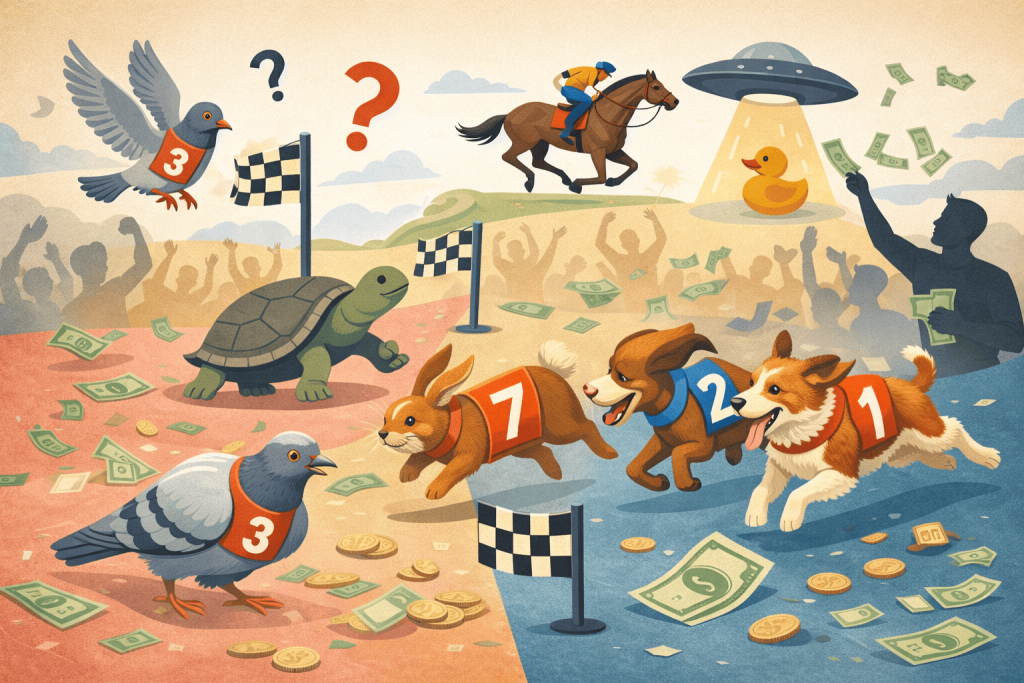
People will bet on almost anything that moves, especially if there’s no clear outcome. Horse racing is the obvious one, but outside of that, things have gotten a bit more creative over the years. Informal bets on dog races, pigeon races, even things as random as which animal reaches a certain point first.
Most of this doesn’t happen in regulated spaces anymore, for obvious reasons. But historically, and even now in smaller, informal settings, if there’s motion and uncertainty, someone somewhere will put money on it.
It’s less about the event itself and more about the unpredictability. If you can’t easily call the result, it becomes interesting.
The Really Specific Bets
Then there are the bets that are so oddly specific they almost don’t make sense.
Things like predicting the exact date something will happen, or whether a very particular event will occur within a certain time frame. These are the kinds of bets that make people stop and go, “Wait, you bet on what?”
Some people have wagered on growing something, building something, or achieving something very niche within a set period of time. The more unlikely or oddly detailed the outcome, the more appealing it seems to become.
The Classic All-In Mentality
Every now and then, you hear about someone taking things to the extreme and putting everything on the line. Not in the sense of a regular casino bet, but in a much more personal way. Everything they own, everything they’ve built, riding on a single outcome.
Sometimes it works, and the story becomes legendary. Other times, it doesn’t, and those stories don’t travel as far. What makes these bets different is the mindset behind them. It’s not casual and it’s not even really about fun anymore. It’s about belief, risk, and a willingness to accept whatever happens next.
Why People Do It
If you look at all these bets side by side, the pattern becomes pretty clear. It’s rarely just about the money; it’s about proving something—whether that’s to someone else, or to yourself. It’s about not backing down once a challenge is out there but rather about that moment where everyone’s watching and you’ve already said, “Yeah, I’ll do it.”
Money definitely gives it weight, but there’s also something about the unpredictability of it all. A normal bet is structured because you know the rules, whereas, one of these types of bets doesn’t always have that. This can make them feel more open and more chaotic, which makes the outcome more interesting overall.
Where It Crosses the Line
Of course, not every strange bet is a good idea. There’s a reason casinos and regulated platforms keep things within clear boundaries. Once bets start involving risk to health, safety, or anything illegal, it stops being entertainment and becomes something else entirely.
The stories that stick around, the ones people actually enjoy hearing, are usually the ones that stay just on the right side of that line. But the funny thing about all of this is that the money rarely ends up being the most important part.
What people remember is the situation. The bet itself, the build-up to it, then the outcome.
Anyone can place a bet on a game, but betting on something completely unexpected turns it into a story. And those are the bets people talk about long after the money’s gone.