There’s something undeniably alluring about the idea of being a professional gambler. The thought of making a living by beating the odds, working your own hours, traveling to glamorous locations, and living off big wins paints a romantic picture. Hollywood has only fueled the myth, turning card sharks and casino mavericks into cultural legends.
But the reality? It is far from the glamorous, carefree lifestyle many imagine. Professional gambling is a high-pressure, mentally draining pursuit where risk, discipline, and emotional resilience are daily requirements, not optional extras. For every headline-making story of a poker champion, there are thousands of untold stories of players who went broke chasing the dream.
The Myth of the “Easy Money” Lifestyle
At first glance, the idea of gambling professionally seems simple enough: find a game where you have an edge, play it smartly, and collect the profits. Yet maintaining even a small, consistent edge over time is one of the hardest things to do in the gambling world. Games are designed to favor the house, and even in skill-based games like poker, it is not just about knowing the rules. It is about consistently outsmarting opponents who are trying just as hard to outsmart you.
Most professional gamblers do not win big every night. In fact, many experience extended losing streaks even when they are playing well. Variance, the natural up-and-down swings of fortune, can make or break a gambler emotionally and financially. Managing that uncertainty takes nerves of steel, meticulous bankroll management, and a willingness to treat gambling like a full-time job rather than a passion project.
Skill Over Luck (But Even Skill Is Not a Guarantee)
Unlike casual gamblers who rely heavily on luck, professionals must operate in spaces where skill predominates. Games like poker, real money blackjack (with card counting), and sports betting offer possibilities for a long-term edge, but those edges are razor-thin and can be wiped out by bad runs, rule changes, sharper competition, or even just one slip in focus.
Take Phil Ivey, often called the “Tiger Woods of Poker.” Ivey’s talent and psychological mastery made him one of the most feared poker players in the world, earning tens of millions in winnings. Yet even he has not been immune to controversy and setbacks. In 2012, Ivey found himself embroiled in a legal battle over edge sorting, a technique he used to gain an advantage in baccarat. Though he maintained that he was playing within the rules, casinos saw it differently, and he ultimately lost court battles to claim his winnings. Even for the best, the road is rarely smooth.
Skill gives you the best shot, but it does not guarantee success. In professional gambling, one bad run or one wrong move can have devastating consequences.
Psychological Pressure and Burnout
Imagine the stress of knowing your income depends entirely on your next session. There is no monthly paycheck, no paid holidays, and no health benefits. Even the most level-headed professionals can find the constant swings emotionally exhausting.
Top poker pro Daniel Negreanu has been open about the mental toll professional gambling can take. In interviews, he has spoken about the importance of mindset training, self-awareness, and even therapy to cope with the swings and the pressure. Without strong mental resilience, it is easy for even experienced players to spiral into tilt, the emotional state where frustration leads to reckless, uncalculated decisions.
It is not just about playing well. It is about continuously playing well, staying disciplined through slumps, and finding motivation when luck appears to have deserted you for weeks or even months.
Financial Risk and Brutal Bankroll Management
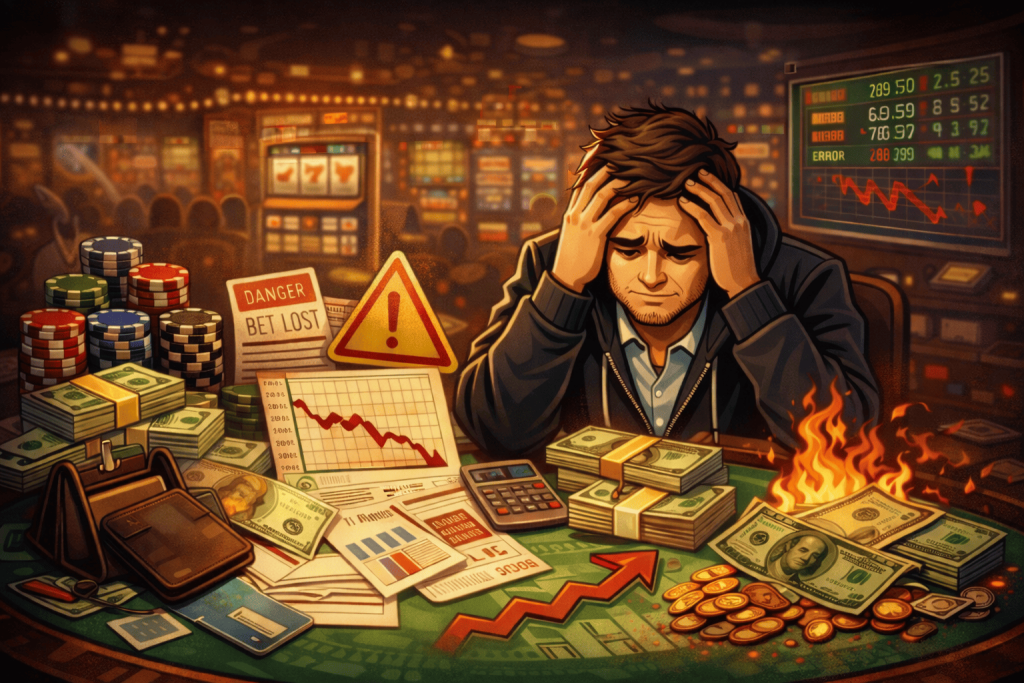
Professional gamblers must be experts in managing their money because variance does not care about your bills. One of the first rules is maintaining a bankroll specifically for gambling, entirely separate from living expenses. Ideally, this bankroll should be large enough to withstand brutal downswings without putting the gambler’s lifestyle at risk.
But even that is not always enough. The line between calculated risk and financial ruin can be painfully thin. One bad decision, one change in the market for sports bettors, or even one small miscalculation can lead to devastating losses. Professionals often grind for months or years just to build up a solid foundation, and a single bad streak can wipe out years of work.
Constant Learning and Evolution
Being a professional gambler is not about mastering a game once. It is about evolving constantly. New strategies, new players, and even new technologies like poker solvers are always shifting the landscape. What worked five years ago might be completely obsolete today.
Professional gamblers often spend as much time studying, reviewing hands, reading data, or scouting betting markets as they do actually playing. It is mentally exhausting work that demands constant self-improvement. Complacency is a killer.
The Isolation Factor
Another hidden challenge is the loneliness. Gambling professionally often means traveling frequently, working odd hours, and spending long stretches in environments like casinos, online poker rooms, or sports betting offices. Social circles can shrink quickly, and the constant hustle can make it difficult to maintain relationships.
Unlike a conventional job, there is no team cheering you on, no office banter, and no guaranteed path to promotion. Success is solitary, and so is failure.
Stories Behind the Headlines
The handful of professional gamblers who reach celebrity status, like Ivey, Negreanu, or Doyle Brunson, are the extreme exceptions, not the rule. For every tournament victory you see broadcast on TV, thousands of grinders are playing cash games quietly to pay the bills, and many others are quietly giving up, burned out by the emotional, financial, and mental demands.
Even the legends are not invincible. Doyle Brunson, a poker icon, often spoke of the dangers and hardships of the professional gambling lifestyle, noting that the games were often dangerous both financially and physically during his early career in underground Texas poker rooms.
Success stories exist, but they are rare, hard-won, and often far less glamorous than they appear from the outside.
Drawing the Line Between Dream and Reality
Being a professional gambler sounds like the ultimate life hack, beating the system at its own game. But the truth is far tougher. It is a life of relentless pressure, self-discipline, and constant adaptation. It demands a unique combination of skill, emotional control, work ethic, and risk tolerance that few possess.
Yes, it can be rewarding. Some make fortunes. Some taste a freedom few other careers offer. But for most, the reality is a grinding, high-stakes existence where today’s success is never a guarantee of tomorrow’s survival.
Before dreaming about life as a professional gambler, it is important to ask: are you prepared to bet everything, including your sanity, on your ability to survive the swings? We know we’re not!